A traditional cheongsam needn’t have a tightly fitted waist or narrow sleeves. Cheongsam, also called qipao (旗袍, qípáo), names a Chinese dress tradition with different forms. A label doesn’t specify a cut. The garment’s making date needs separate evidence.
A traditional cheongsam can have a broad outline
The yellow-green example below has a long patterned body beneath a standing collar, with pale sleeves spreading widely to either side. The body hangs well below the sleeves, and its hem remains visible. Seeing those parts together gives a fuller description than a small portrait cropped at the waist.
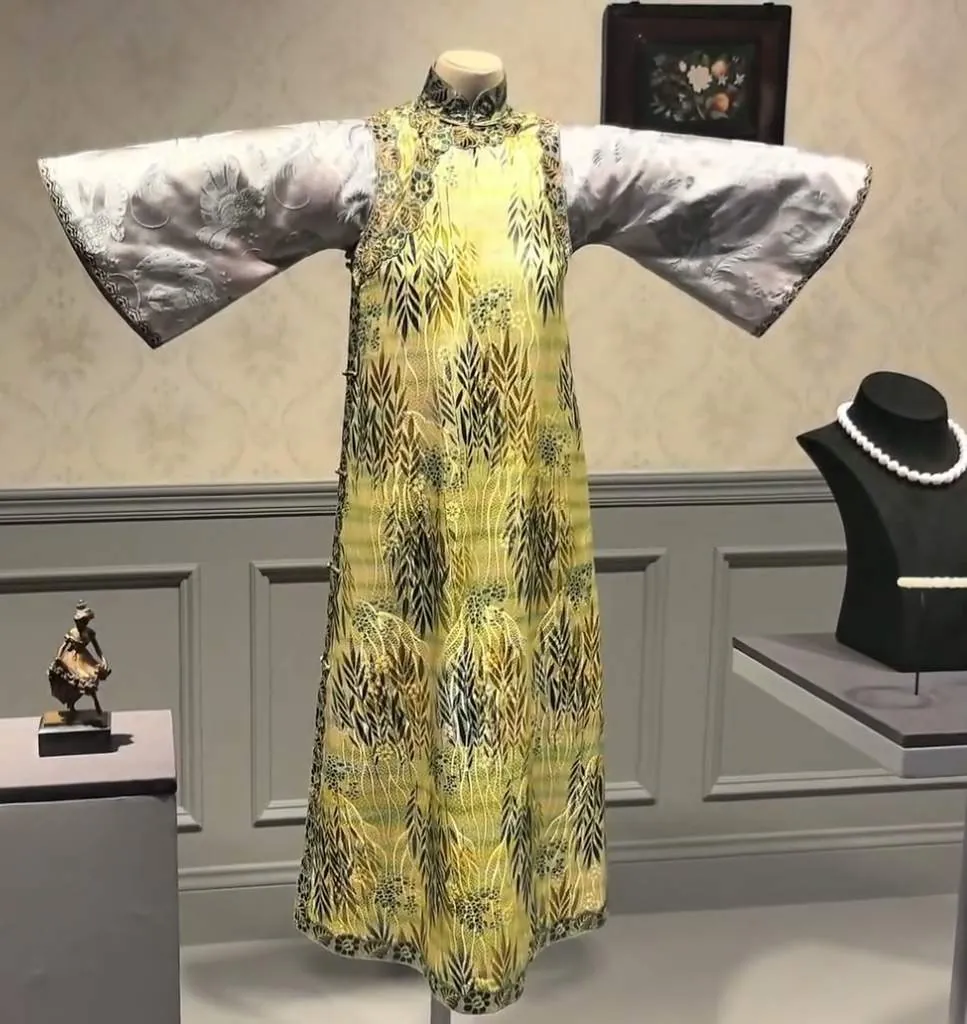
The sleeves spread beyond the body. Their breadth is easy to miss if the familiar close-fitting cheongsam is the only shape you expect. Compare the sleeves with the long central body without turning this example’s proportions into a rule for every dress called traditional.
For the wider vocabulary, our guide to traditional Chinese clothing places qipao alongside robes, separates, and other dress traditions. Here, the question is narrower: what can the parts of a particular cheongsam actually show?
A cheongsam’s front border and opening need separate checks
The broad outline leads to a smaller question at the chest. In the closer view, a contrasting edge curves around the standing collar and continues diagonally across the upper front. The pale sleeve surfaces meet the patterned central area near the shoulders.
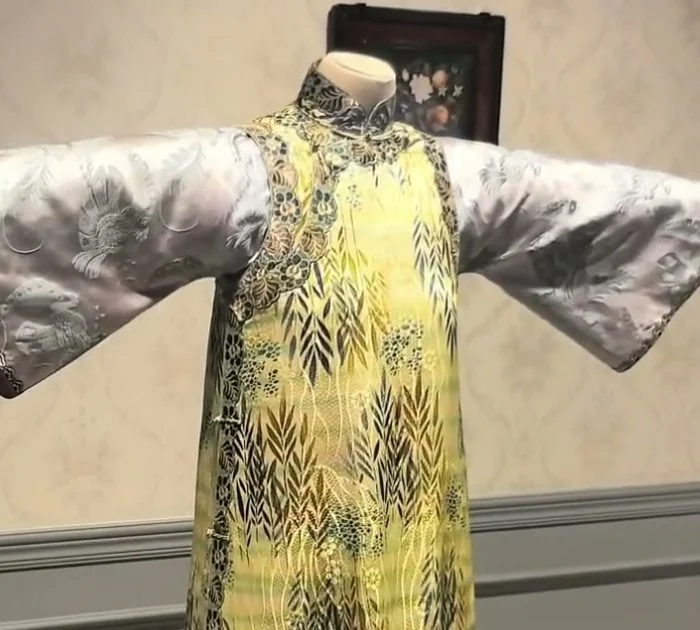
A visible border gives the eye a line to follow. The dress hasn’t been opened here. To trace the opening, ask for an opened view or a construction record. Decoration can outline an area without revealing every fastening, seam, or layer behind it.
Keep the description tied to what is visible. “A diagonal front edge” describes this view; “the entire opening runs along that edge” adds a claim the view hasn’t established. Likewise, a sleeve junction is a place to inspect more closely before deciding how the cloth was cut and joined.
The distinction also helps when comparing garment names. Our explanation of hanfu and qipao covers their different scope and dress histories. A shared collar detail by itself won’t settle the identity or construction of the whole outfit.
What does “old-style cut” mean on a new cheongsam?
Looking beneath a border takes us from appearance to making, where the word traditional needs a more precise explanation. A maker may use it to describe the approach followed in a newly made garment. The age of that finished garment is a separate question.
The independent maker Qi Xiaocai (绮小裁) calls one making project gufa yipianshi qipao (古法一片式旗袍), roughly “old-method, one-piece-cut cheongsam.” That’s the maker’s term. The making material includes paper patterns and red patterned cloth; it isn’t a construction record for the yellow-green dress above.
The useful next question is what the maker means by the cut. A dress that is one garment and a garment cut from one piece of cloth are different claims. Counting the complete pattern requires the full layout, including parts that a single worktable view may leave outside the frame.
These labels answer different questions:
| Description | What to ask for |
|---|---|
| Traditional or old-style | The particular form or method being followed |
| One-piece cut | The complete pattern layout and an explanation of which parts are counted |
| Historical original | A dated record for that individual garment |
| Reproduction | The object, image, or pattern used as its reference |
Ask for the evidence that matches the description. An attractive pattern or a standing collar can help describe the appearance, while a dated object record and a complete cutting layout answer quite different questions.
Jiejin explains front overlap through a paper model
A paper model can make one part of a cutting method clearer without supplying the whole pattern. In a demonstration by the maker posting as Shui Xing Wo Bian Xiao Gou Chang La (睡醒我变小狗肠啦), jiejin (借襟) concerns the overlapping front: the outer front lies over an under-front section.
The maker cuts and rearranges a folded paper model. Near the end, the demonstration identifies an area where the front and under-front overlap. That extra covered area is the useful point to follow: the visible outer edge and the edge of the cloth underneath occupy different positions.
The paper sections overlap. That isn’t an adult fitting. Translating the model into a garment would require a full pattern, measurements, fabric, and fitting. A small paper demonstration can’t supply those choices or establish how the yellow-green garment was made.
Keep a full view beside a close view of the upper front. Ask where the opening is, what lies beneath it, and which construction evidence supports the description. The China in Threads home page provides the wider clothing and accessory guide.