Traditional Chinese clothing covers dress traditions across China’s periods, regions, and ethnic communities. Hanfu (汉服) describes Han Chinese dress and its contemporary revival; qipao (旗袍), also called cheongsam, is a dress with a distinct history. Neither name covers the whole field.
The names are a starting point. A sleeve edge, a fastening, or the layers beneath a robe can tell us more about an outfit than its color. The guide begins with the names, then follows those details through historical clothing, modern reconstructions, and clothes made to wear today.
What is traditional Chinese clothing called?
The name depends on the garment. Hanfu covers a broad field of Han Chinese dress, while qipao usually refers to a long women’s dress. A Tang suit generally means a jacket, including modern designs that combine older details with newer tailoring.
Use the names below to narrow a search. The table separates categories from individual garments so a photo of a robe doesn’t have to fit the same definition as a jacket.
| Name | What the name helps identify | What to examine next |
|---|---|---|
| Hanfu | Han Chinese dress traditions and newly made clothes drawing on them | The particular garment, period reference, and construction |
| Qipao, also called cheongsam | A women’s dress associated with modern Chinese dress history | The date, cut, collar, sleeves, and opening of the particular dress |
| Tang suit (唐装, tangzhuang) | A Chinese-style jacket; modern examples often have a standing collar and knotted fastenings | Whether the description refers to a modern jacket or clothing of the Tang period |
| Chinese ethnic dress | Clothing identified with particular communities and places | The community, locality, wearer, and occasion recorded with the garment |
Hanfu is broader than a single robe shape. For its Ming project, the China National Silk Museum discusses both faithful and freely interpreted modern hanfu. Ask which garment a label means before judging its historical accuracy.
Other names describe pieces within an outfit. A robe, an outer coat, and a jacket-and-skirt ensemble need different descriptions even when all three appear under one broad label. The China in Threads home page maps the wider clothing and accessory sections.
Chinese robes and separates: look beneath the silhouette
Start at the neck and follow the opening downward: does one front cross over the other, do the fronts meet, or does the opening turn toward a side? Then look below the waist for separate layers. A long outline can hide several garments.
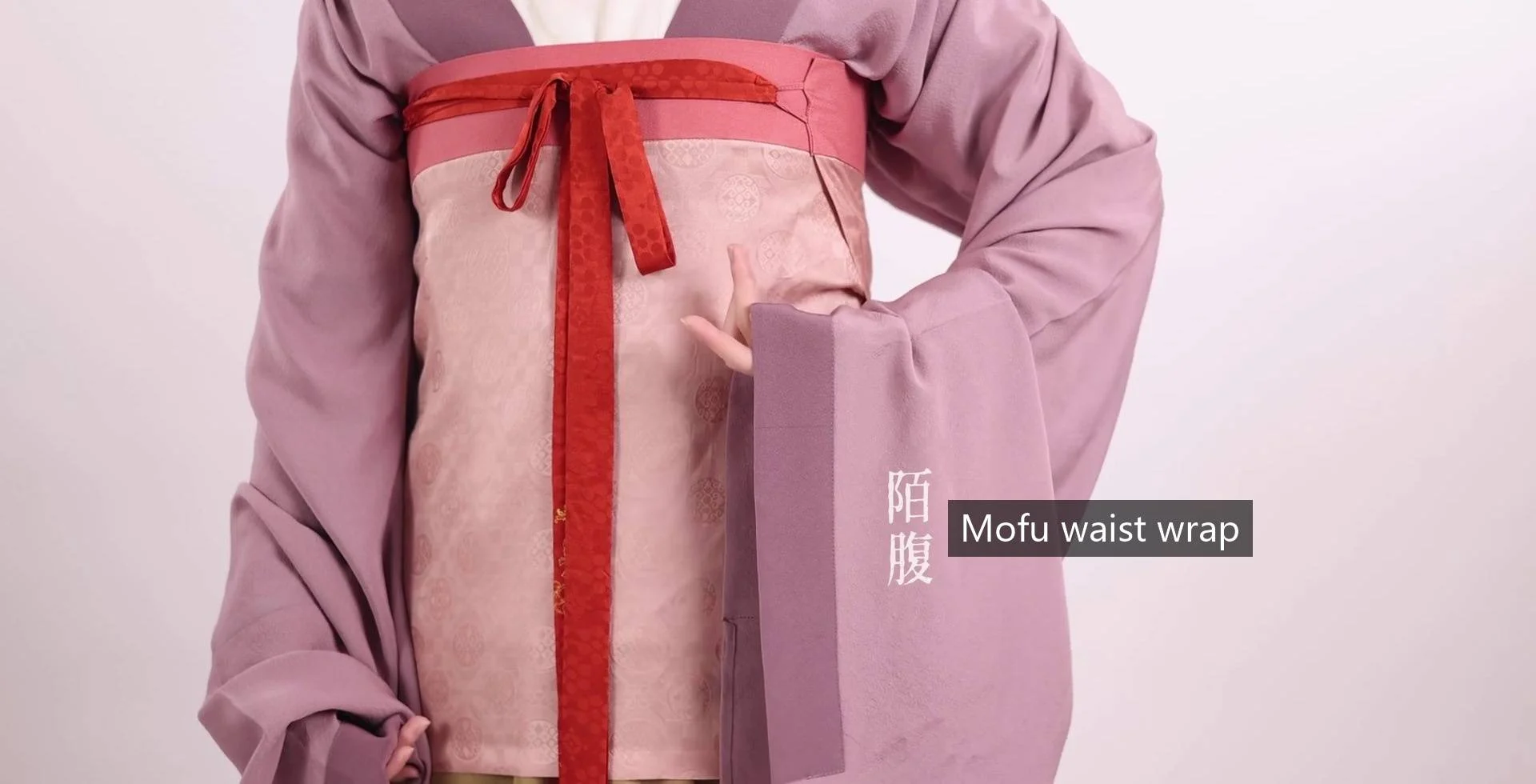
In the reconstruction below, a pale pink panel covers the torso between purple sleeves. A red tie runs across its upper edge before falling in long ends. Follow the panel where it meets the sleeves: the contrasting colors make the separate surfaces easy to see.
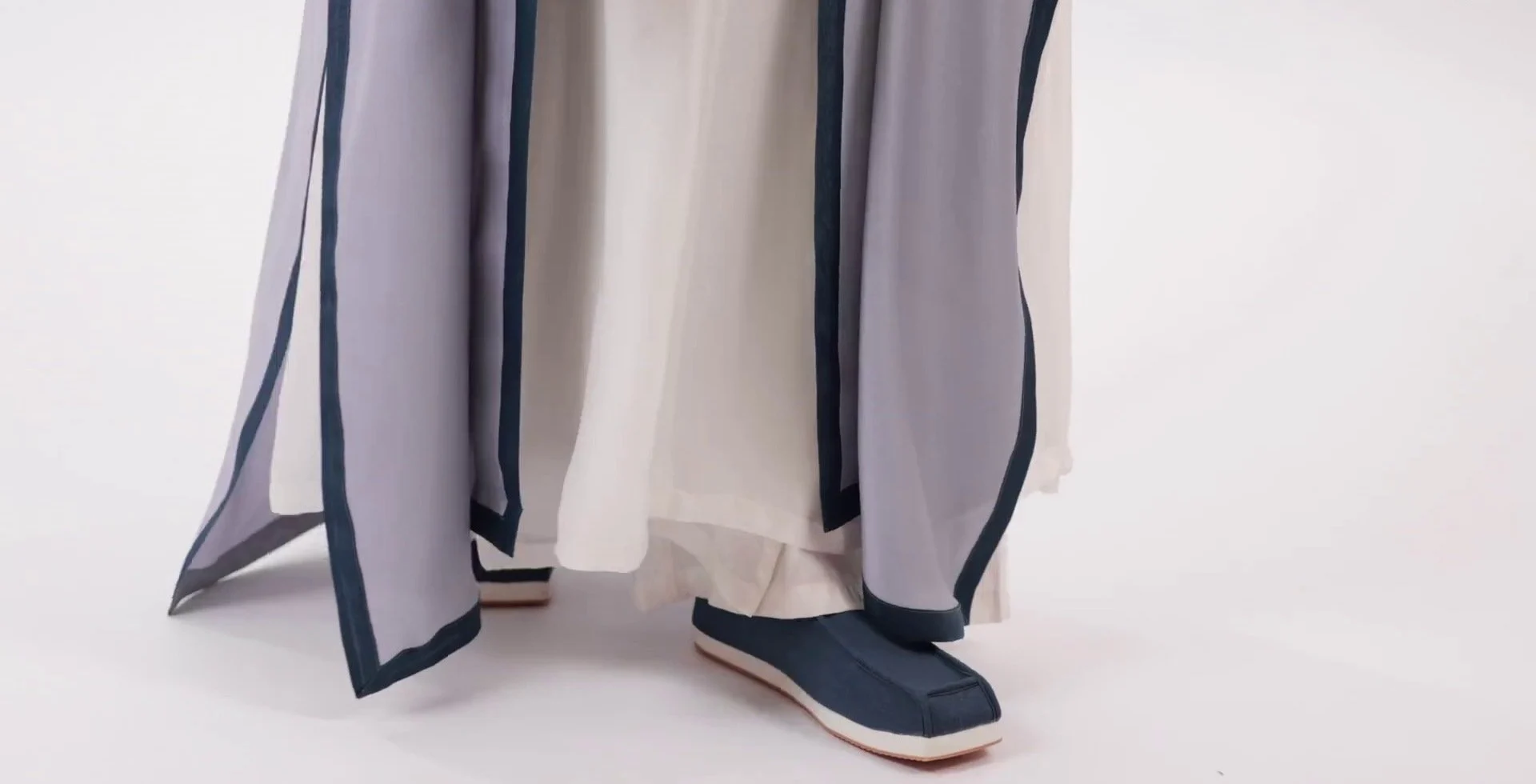
The hem can reveal what the torso conceals. In the gray-blue outfit below, the thin outer layer ends beside pale inner layers and white trouser legs. Dark edging outlines the outer cloth, while the shoes remain separate from the long silhouette.
A crossed collar, wide sleeve, or belt is a clue to investigate further. The combination matters: how the opening closes, how the sleeves join the body, what is worn underneath, and what evidence accompanies the garment. A single collar shape can’t supply all those answers.
Chinese clothing changed: from court robes to cheongsam
Layers describe construction; dates and occasions explain who wore a particular combination. A formal robe, an everyday jacket, and a twentieth-century dress answer different needs. They can all enter a history of Chinese clothing without becoming interchangeable versions of the same outfit.
Consider the Met’s nineteenth-century robe-and-coat ensemble, object 44.79.3. The darker coat closes down the front over a more elaborate robe. The museum identifies it as formal wear for a nobleman’s or official’s wife on auspicious occasions such as birthdays.
Qipao brings a different historical setting into view. The National Heritage Board’s qipao record places its popularity in Shanghai from the late 1920s. It describes a high collar, side slits, and ornamental fastenings near the collar and opening.
The qipao and robe-and-coat ensemble belong to different periods and settings. The date and recorded use matter alongside the garment’s shape; neither example stands for every kind of Chinese clothing worn at the time.
The Ministry of Foreign Affairs describes the 2001 Shanghai APEC jackets as combining standing collars, matching front edges, and knotted buttons with modern shoulder and sleeve construction. They’re modern Tang suits; the name alone doesn’t date a jacket to the Tang dynasty.
For historical identification, begin with a dated object record, where the garment’s place, materials, and recorded use can be checked together instead of leaving its familiar name to supply the missing history. Those details distinguish one version from another.
Patterned cloth and contrasting edges in Chinese dress
Once a garment has a historical setting, its cloth deserves a closer look. Separate the main fabric from its borders, cuffs, and lining. A small strip at an opening can have a different color and pattern from the large body panels, making the garment’s outline easier to follow.
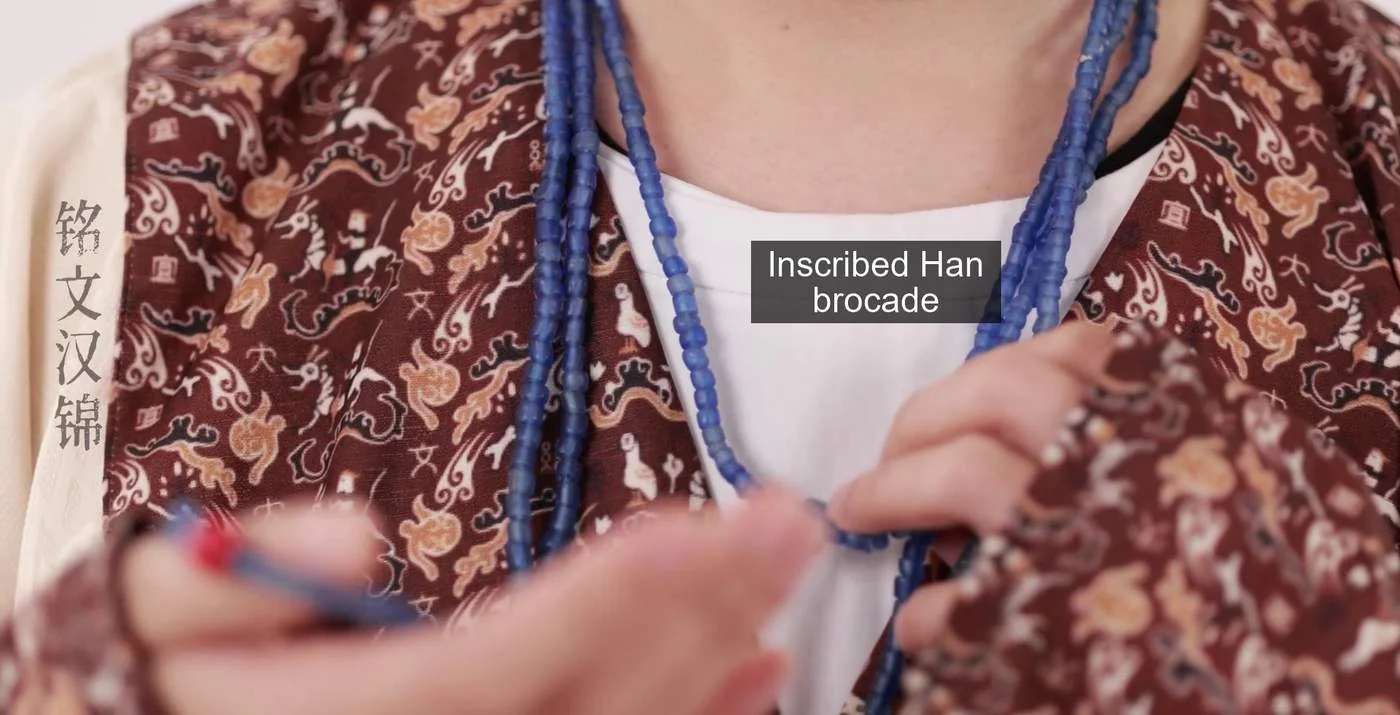
The brown-red patterned layer sits over a white inner garment, with blue bead strands in front. The contrast separates cloth, inner layer, and ornament: the beads add detail without being part of the patterned fabric.
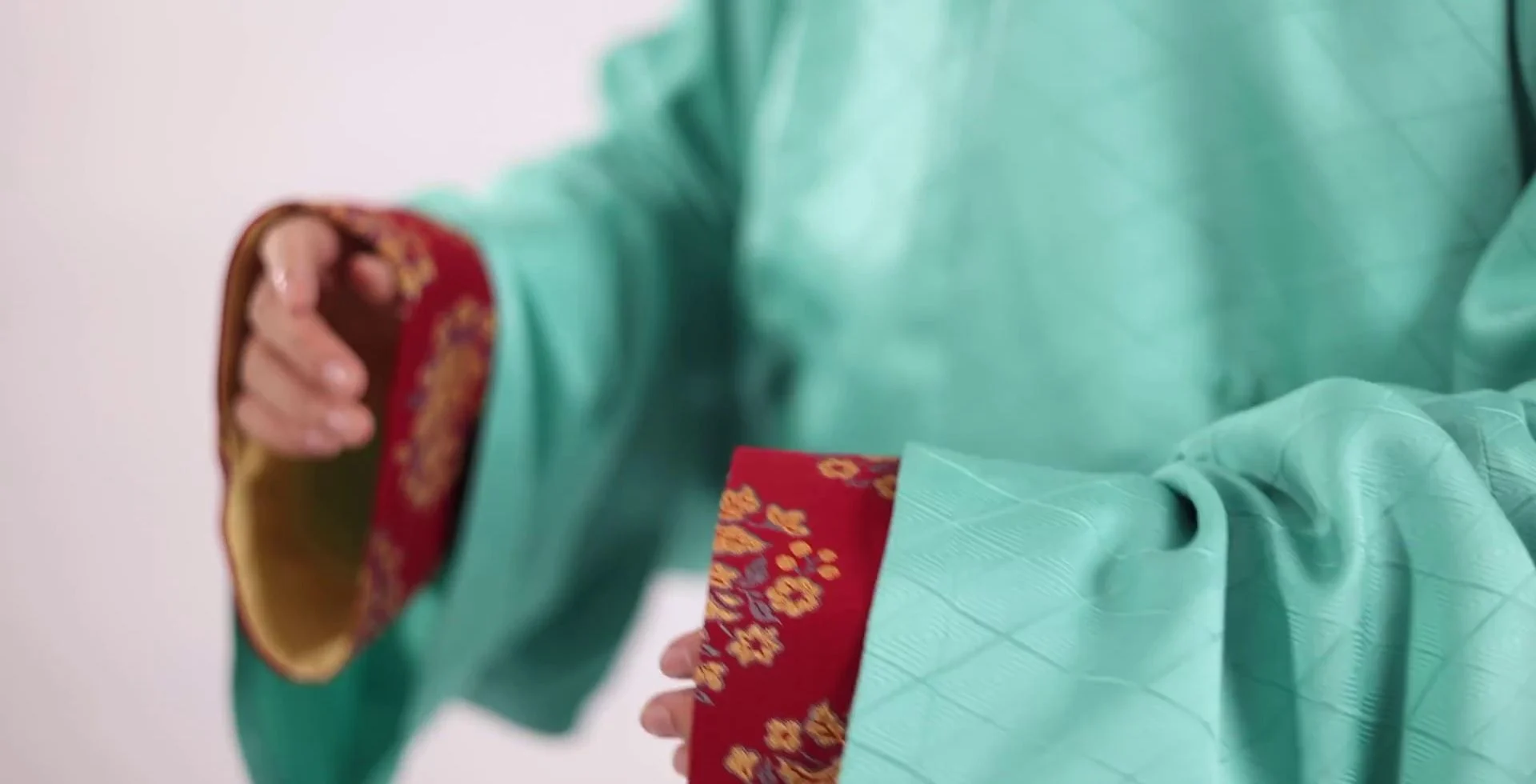
A cuff makes another distinction visible. The turquoise sleeve below meets a red floral edge, with a gold-colored inner surface. Follow the border around the opening before deciding whether an apparent extra layer is a separate garment or part of the sleeve. A front-facing full-body photograph can hide that junction.
The Autry Museum’s Chinese railroad worker’s jacket, dated around 1900, is recorded as striped cotton with Chinese-style knotted closures. Work clothing brings other fabrics into a field often associated with silk court robes.
For a modern purchase, check the stated fiber content separately from the garment’s name. Gloss shows how a surface catches light; it doesn’t identify the fiber. That requires a label or documented textile analysis.
Chinese belts, fans, and hair ornaments belong to the outfit
The patterned cloth continues into a dressed ensemble through the objects worn with it. A belt, a fan held at the waist, or an ornament set in the hair changes what is visible around the garment. Their positions are part of reading the outfit, even when a search result crops them away.
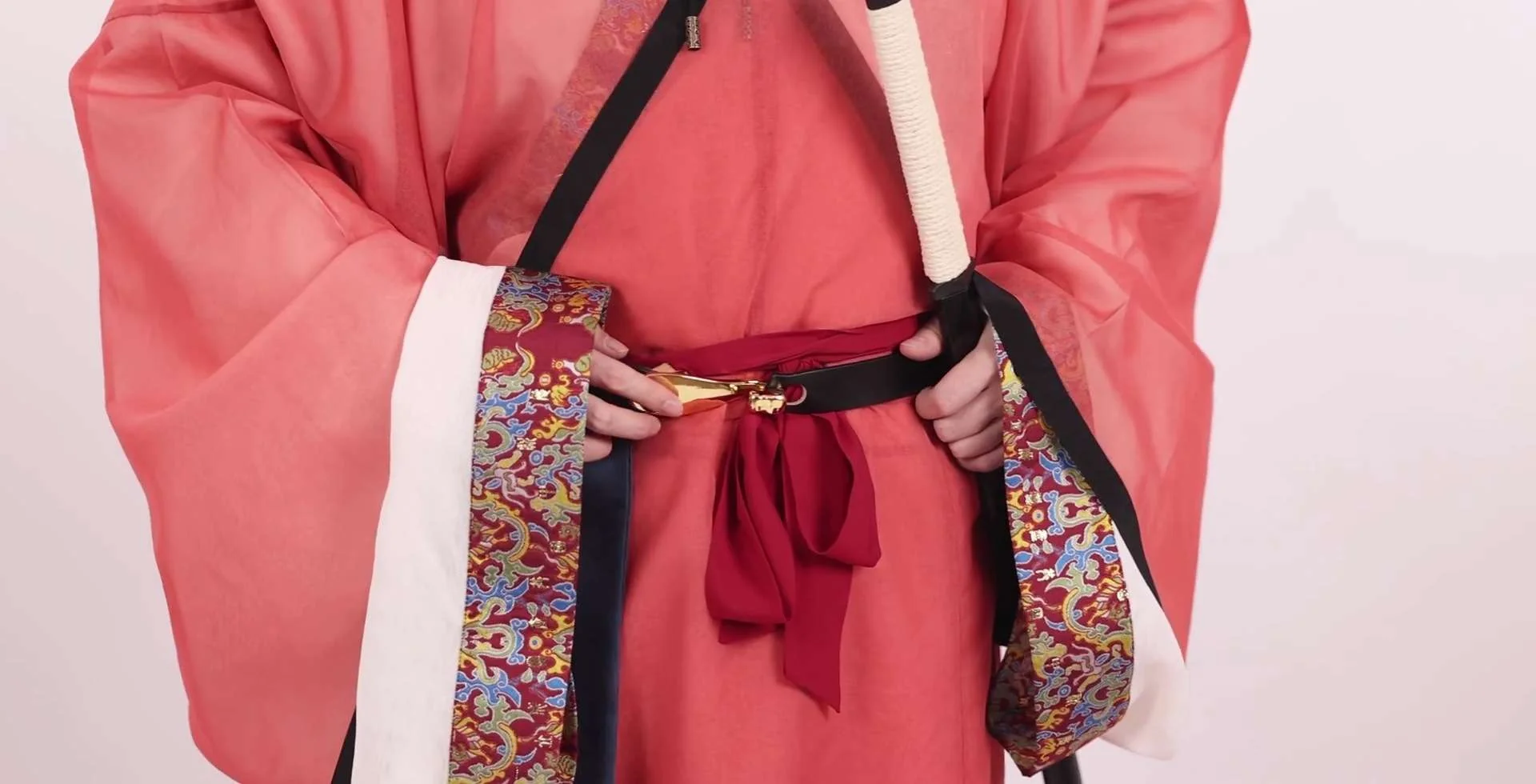
The red robe below has both a soft red tie and a dark belt with metal-colored fittings. A sheathed sword sits beside them, while pale inner sleeves and patterned cuffs frame the waist. The picture shows several objects sharing a small space; their presence alone doesn’t establish a wearer’s historical rank.
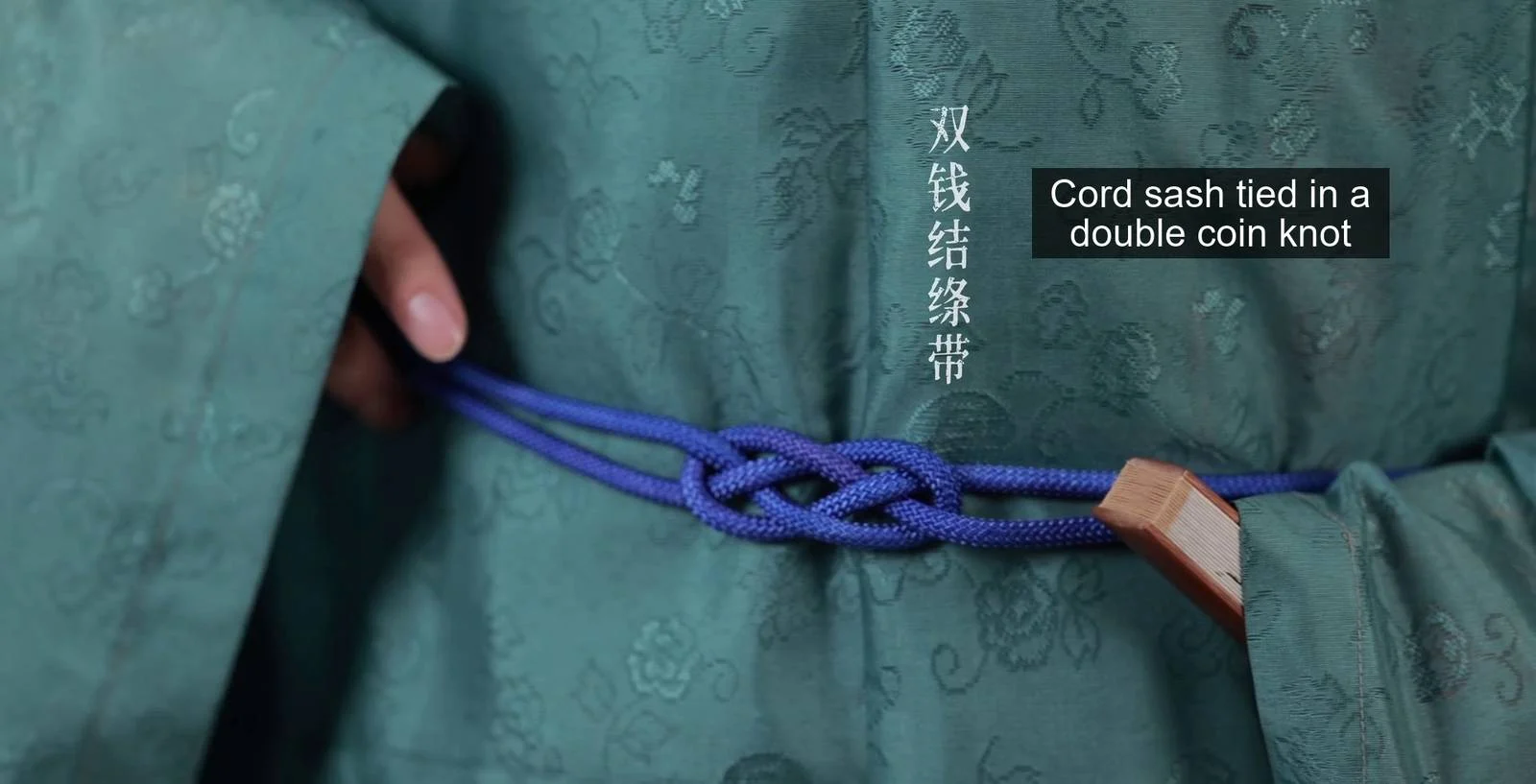
The blue-purple cord on the teal robe works differently as a visible detail. Its intertwined loops form a double coin knot, with a wood-colored fitting at one end. Here the cord and knot give the eye a firm horizontal line across the softer folds and near-matching pattern of the cloth.
Fans and hair ornaments extend that reading beyond fastenings. A fan is a separate object carried with the clothes; a hair ornament attaches above the collar. Their placement helps explain the complete outfit alongside the garment itself.
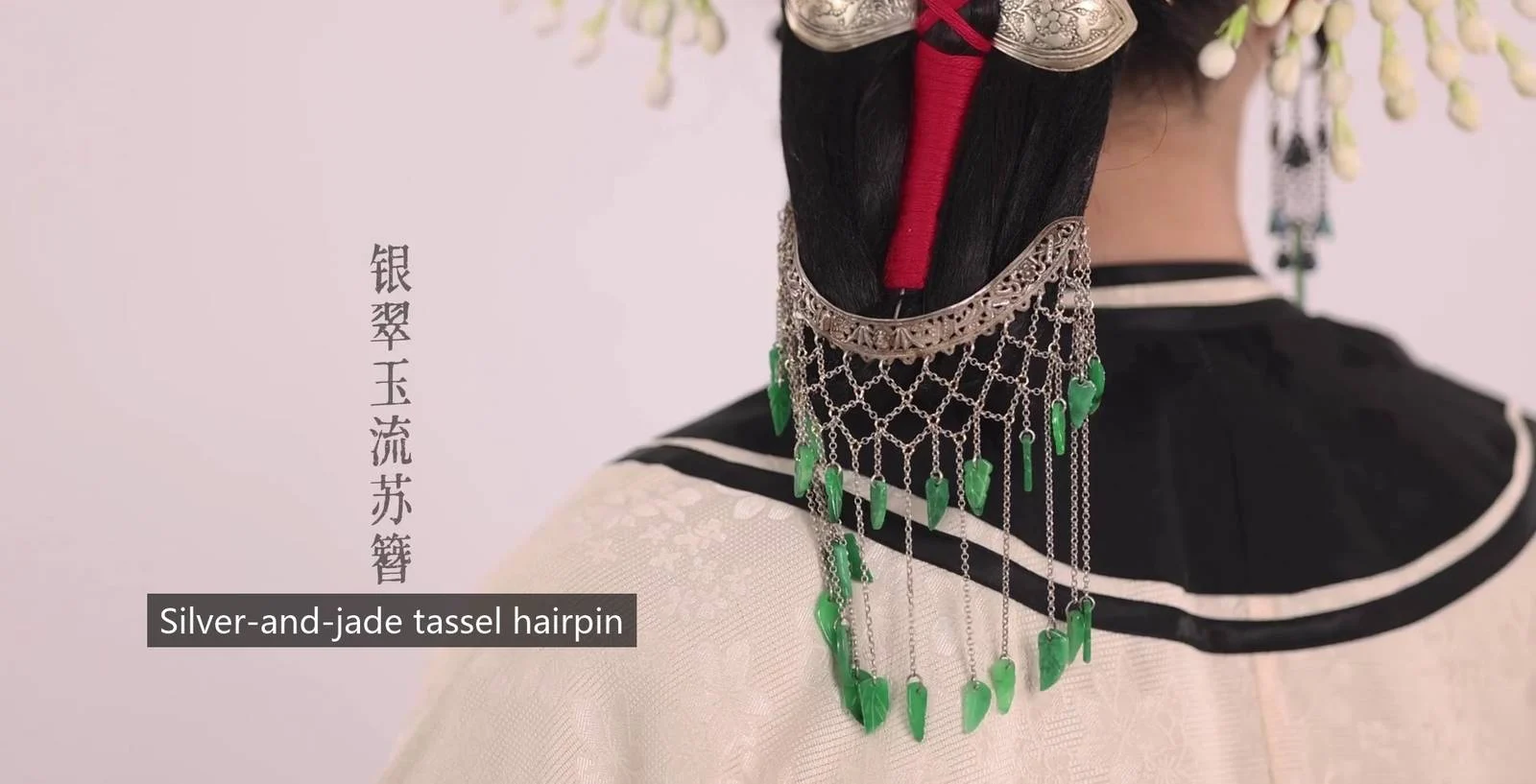
At the back of the head below, a curved ornament carries chains and green drops above the collar. That gap makes the hanging chains easy to see. Shape and placement give a starting description before any claim about symbolism.
Chinese ethnic dress extends beyond the hanfu–qipao comparison
Chinese clothing includes dress associated with different ethnic communities, localities, and ways of life. Hanfu and qipao name parts of that field. Clothing from other communities needs its own names and context, as the following museum example shows.
A Miao woman’s jacket and skirt in the Met’s collection, object 1987.45.2a,b, makes that wider range concrete. The museum describes a hemp jacket and a carefully pleated linen skirt, with decoration concentrated in bands. The community name is part of identifying the clothes.
For an unfamiliar garment, start with the community and place named in its record. Then check who wore it and for what occasion. A label saying only ethnic costume leaves several questions open; a locality and a documented use give the reader something more precise to investigate.
The same care applies to historical images. Shape and placement can describe an accessory, but decoration alone may not identify it. A name supplied by the wearer or community can give the missing context.
Reading Chinese clothing photos: original, reconstruction, or adaptation?
The final check is the kind of evidence behind the outfit. A surviving historical garment, a modern reconstruction, and a contemporary design can look similar in a small image. Each answers a different question, so the distinction belongs beside the clothing rather than hidden behind a claim of authenticity.
The detail photographs here show modern reconstructions: selected outfits with some interpretive choices. They show clothing details on a dressed body, not a complete wardrobe for each period. Historical dating still needs supporting objects, images, or texts.
The China National Silk Museum’s Ming project presented excavated clothes, conserved objects, and replicas as distinct parts of its work. Those stages separate surviving evidence from the choices needed to make a garment wearable again.
For a historical reference, look for a named object, dated image, or text behind the reconstruction. For clothing to wear now, ask which details were retained and which were changed for fit or use.
Keep a front view, a view of the opening, and one clear detail of the hem or sleeve when comparing clothes. Add the source’s date and description beside them. Those few pieces of evidence give the next question somewhere to begin: which parts of this outfit can actually be identified?