A Chinese jade bracelet comes in more than one shape. The two objects below are both Chinese jade bracelets: a wide cuff and a thin bangle. They come from different periods, so compare them as two forms, each on its own date.
The Met’s records give the useful facts. Object 44306 is a wide jade (nephrite) bracelet from China, dated ca. 2400–2000 BCE, with a diameter of 3 3/8 in. (8.6 cm) and a width of 2 in. (5.1 cm).
Object 43356 is a thin jade bangle from China, dated to the 20th century, with a diameter of 2 13/16 in. (7.1 cm) and a depth of 1/2 in. (1.3 cm).
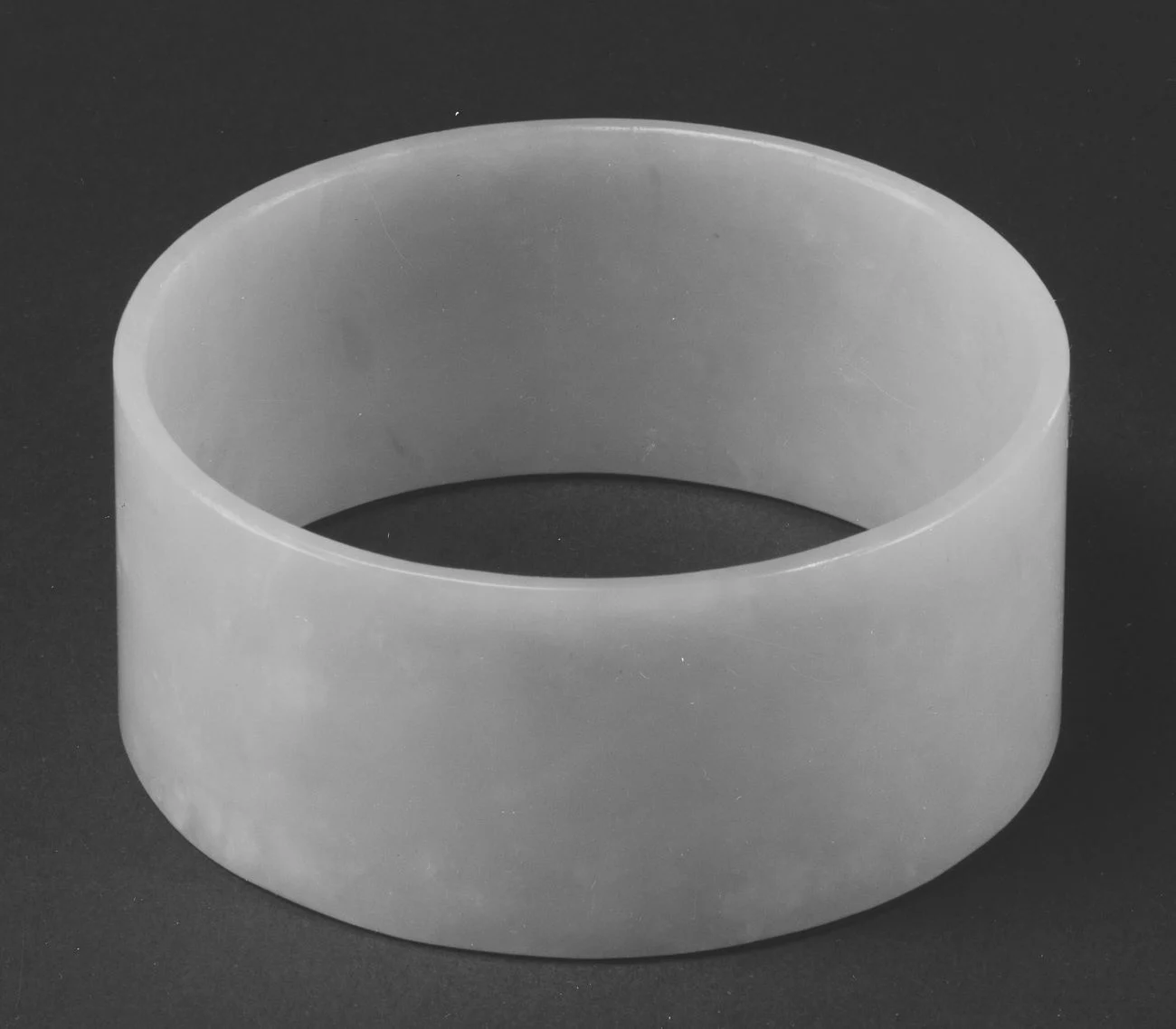
The wide cuff is a broad band
The first object is a broad, cylindrical band. In the photograph it reads as a solid pale cuff with a smooth outer face, set against a dark background.
The Met labels the material as jade (nephrite), the culture as China, and the period as Neolithic; it dates the object to ca. 2400–2000 BCE.
The photograph shows the form: a deep band rather than a narrow ring. The Met gives an outside diameter of 3 3/8 in. (8.6 cm) and a width of 2 in. (5.1 cm). Those figures describe the outside of the cuff; the record does not give an inner diameter or a weight.
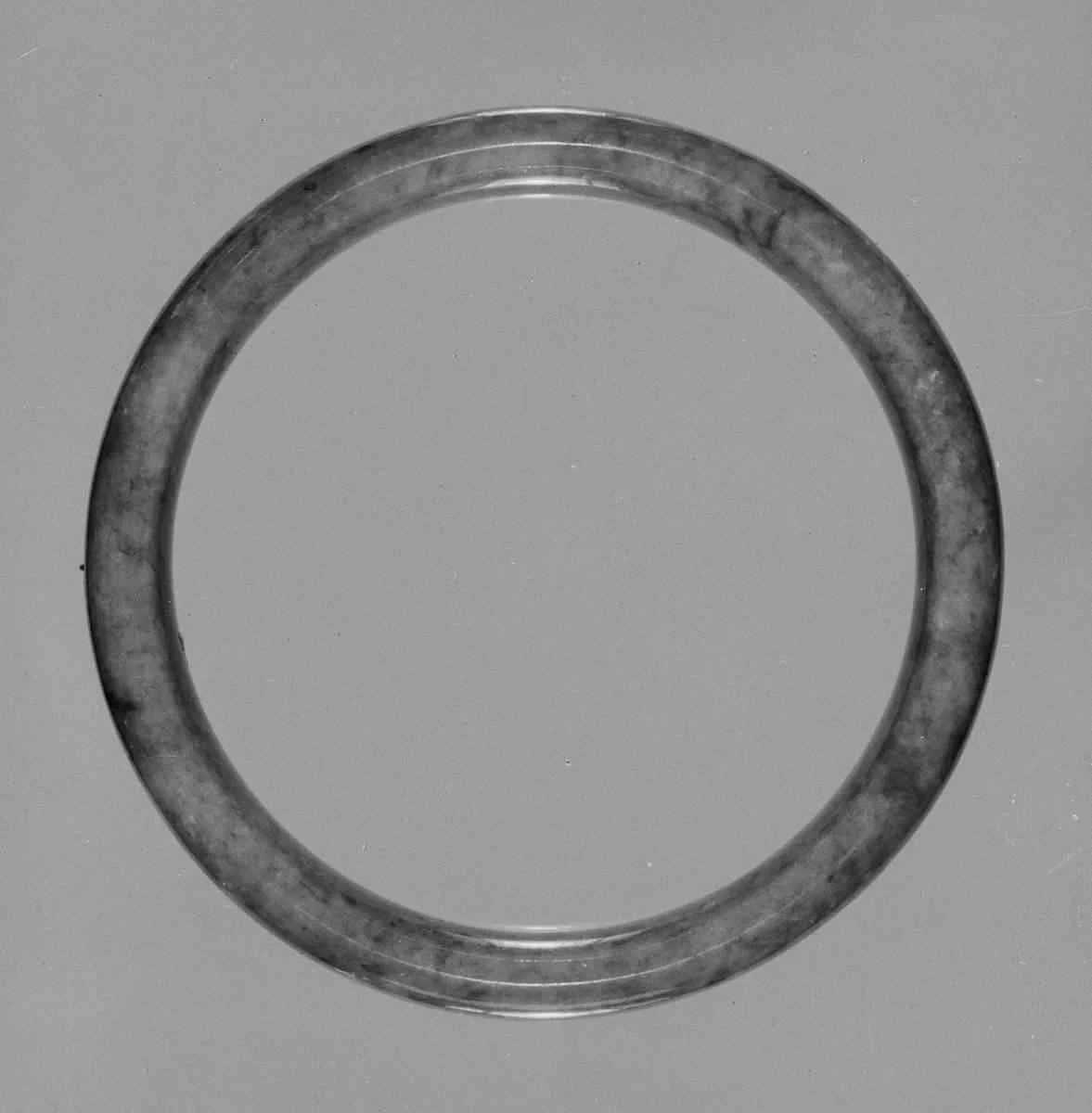
The thin bangle is a narrow ring
The second object is much narrower: a thin circular bangle, photographed in black and white on a gray background. The Met labels the material as jade and the culture as China, and dates the object to the 20th century.
A black-and-white photograph records outline and tone, while color sits outside what it can show.
You can see how thin the ring is and how little metal or stone sits on it. The shade of the jade stays open in this image; the label says jade, and the photograph leaves the exact color unrecorded.
The Met gives a diameter of 2 13/16 in. (7.1 cm) and a depth of 1/2 in. (1.3 cm). Those figures describe the ring as cataloged; the record does not give an inner diameter or a weight.
How to tell the two jade bracelet forms apart
The quickest distinction is width: a deep cuff against a thin ring. Material is the second: the Met labels the first nephrite and the second jade, and both records give China as the culture. Surface is the third: both objects show a plain band, with no inlay on either one.
Fit is the part the records leave open.
The Met gives outside diameters and widths, but a bracelet sits on the inside of the wrist. A wide cuff and a thin bangle can share an outside diameter and still sit differently, because the width of the band changes how the piece rests. Inner diameter and weight stay outside both records.
What the two jade bracelet records leave open
These objects come from separate periods: a neolithic cuff and a 20th-century bangle. Each stands on its own date; read them as two surviving examples, one from each period.
Meaning stays open. A bracelet can serve as ornament, a status marker, or a gift, and the objects carry more than one possible explanation. The Met’s labels describe material, culture, date, dimensions, and grouping; this guide stays at that level.
If you are choosing a jade bracelet, start with the form you can see: a wide cuff or a thin bangle.
Then ask for the two measurements the records do not give: inner diameter and weight. The Met’s outside diameter and width are a starting point, while the inside measurement is the one that decides fit.