Traditional Chinese jewelry is the ornaments worn on the body and the fittings attached to dress, from a Stone Age jade cuff to a twentieth-century silver bracelet. That span is why the category is wide, and why one object can’t explain the whole.
The useful way in isn’t a timeline. It’s three questions you can ask in front of any case: what is it made of, what shape is it, and what does the label actually say? Those three do more work than a date range.
This page covers what the category includes, the materials, the main forms, where reading a motif stops being safe, and how to read a museum label. The collection’s specific guides take each form further.
What traditional Chinese jewelry covers
Traditional Chinese jewelry covers ornaments worn on the body and fittings attached to dress. Hair ornaments, earrings, necklaces, bracelets, and rings are the familiar groups.
Belts, toggle sets, and decorative fasteners belong here too, because each one does a practical job and an ornamental one at the same time.
The boundary is easier to state than to hold. A belt hook holds a belt, a toggle set closes a garment, and a decorative fastener keeps a collar in place.
None of these fittings is a ring, and all of them sit in the same museum case for the same reason: they finish the dress and they’re made to be looked at.
The category doesn’t describe one style. A Stone Age jade cuff, a gilded hairpin, and a twentieth-century silver bracelet can all be traditional Chinese jewelry while sharing almost nothing in form or technique.
Materials in Chinese jewelry: jade, metal, and stone
Once you know what counts, the next question is what it’s made of. Jade is the material usually tied to Chinese jewelry, but it isn’t the only one.
Gold, silver, gilt metal, turquoise, coral, pearl, glass, and semiprecious stones all turn up, and the material name on a label is a starting point, not a rank.
Jade itself needs a second look. Museum records may use jade as a general word, or split nephrite from jadeite.
The Met’s record for a wide cuff, object 44306, reads “Jade (Nephrite)”; its record for a thin bangle, object 43356, reads only “Jade”. One names the stone, the other leaves it open.
That gap matters when you compare two pieces side by side. A label that says only jade doesn’t tell you whether the stone is nephrite or jadeite, and color alone won’t settle it.
Ask for the stone name in writing, and treat a photograph as decoration, not evidence.
Forms of Chinese jewelry: hairpins, earrings, necklaces, bracelets, belts
Shape matters as much as material, and the names do different jobs. Hair ornaments show the range clearly. A hairpin can be a plain rod, a carved plaque, or a compound ornament with dangling parts, and the same word covers all three.
Earrings, necklaces, and bracelets follow the same rule: the name says where the piece is worn, not what shape it has. Bracelets show the same range.
The Met holds a wide nephrite cuff (44306, ca. 2400–2000 BCE) and a thin jade bangle (43356, 20th century): two objects that share one word and almost nothing else.
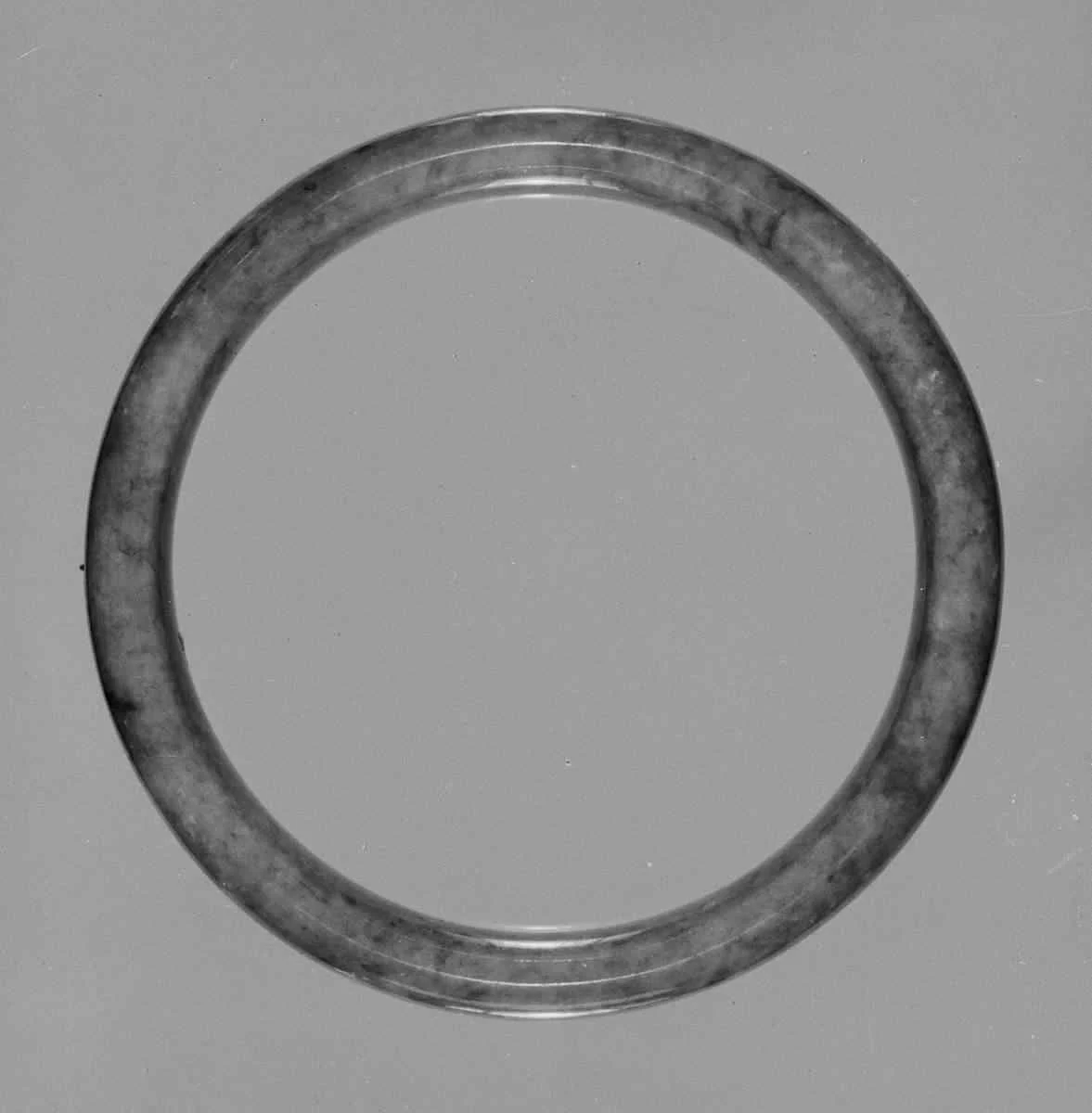
Read that pair as two different answers to the same question. If a seller says “jade bracelet” and stops there, you still don’t know whether you’re looking at a deep cuff or a narrow ring, and the two sit on the wrist differently.
Motifs on Chinese jewelry: what you can see and what you cannot infer
Once the material and the form are clear, the surface is the next thing you notice. Chinese jewelry often carries a motif, a flower, a bird, a cloud, or a geometric band, and the motif is the part a record rarely explains.
A museum record is built to name things. The Met’s entry for object 44306 has fields for the object name, title, culture, period, dynasty, date, medium, dimensions, and credit line. None of those fields is a meaning field.
The same flower can be plain decoration in one period and a specific wish in another. A label usually records the object, the date, the material, and the culture; it doesn’t always record what the motif was understood to mean.
So ask where the meaning comes from. A text from the same period, a later commentary, and a dealer’s description are three different kinds of evidence, and only the first sits close to the object. If the source isn’t named, treat the meaning as a proposal.
How to read a Chinese jewelry museum label
All of that reading starts with the label, and a useful label answers four questions in a fixed order. The object name tells you what the museum thinks it is.
The date or period places it. The material names the stone or metal. The accession number identifies the record you can look up later.
The Met’s records add a culture field and dimensions. Object 44306 is listed as a bracelet, jade (nephrite), China, ca. 2400–2000 BCE, with an outside diameter and a width.
Object 43356 is a bracelet, jade, China, 20th century, with a diameter and a depth. The fields are consistent; the answers aren’t.
The culture field is easy to skip. Object 56226 is a jade bracelet with gold and enamel inlay, dated 18th–19th century, and its culture field reads India, with the period given as Mughal (1526–1858).
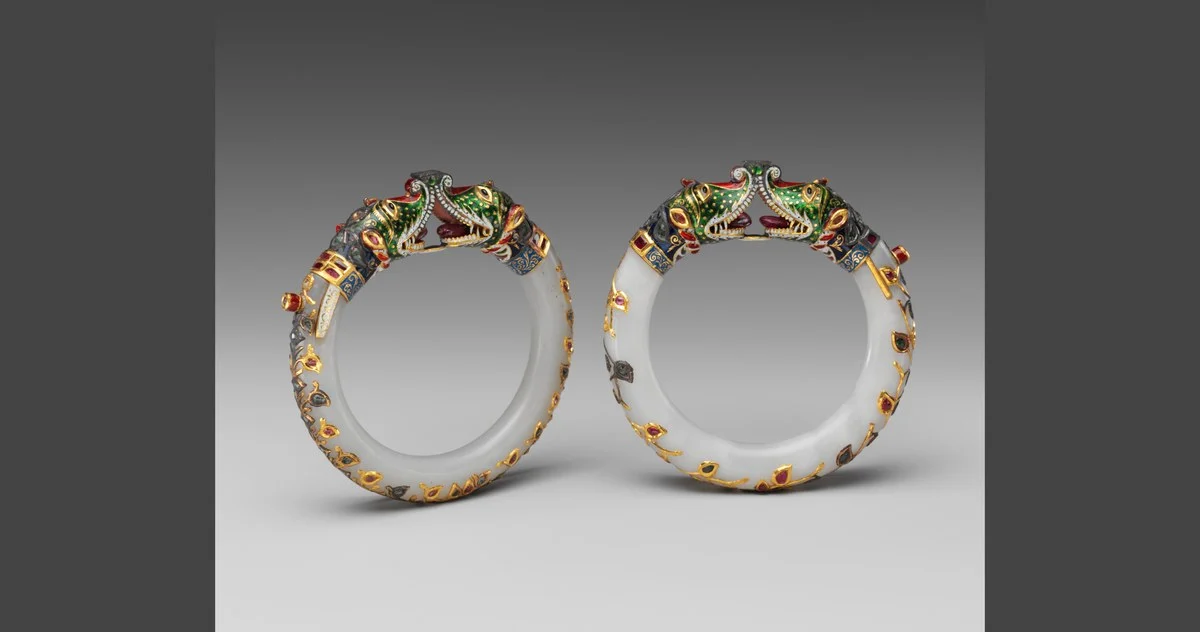
Jade doesn’t make a piece Chinese. The culture field does, and the record for 56226 is the proof.
What the label leaves out matters just as much. A label usually doesn’t give an inner diameter, a weight, or the name of the workshop. Those gaps decide fit, and you can’t close them from a photograph.
Ask for the measurement the label omits, and ask what it was measured across.
Where to start in this Chinese jewelry collection
If you’re standing in front of a case, start with the form you can see. If it’s a bracelet, the bracelet guide separates a wide cuff from a thin bangle and shows what each record does and doesn’t give.
If the question is the stone, the guide on jade and jadeite handles that comparison.
The collection adds a guide as each form is ready, and each one stays close to the objects and records it can cite. Start with the form you can see, then follow the label.