Jade meaning, in the Met’s own words, is tied to the values attached to the stone: its gentle color reflects benevolence, its soft luster suggests humility, and its extreme hardness and durability call to mind integrity.
The three objects below show that material worked in different forms; their own records do not assign those values to a particular piece.
None of the three says what the object was for, or what it meant to the person who owned it.
The first piece makes that gap easy to see. It is a Qing-dynasty tube carved after a much older jade.
The word “after” in its label is the most useful word in the entry. The shape was worth repeating, and this is not the piece the shape was invented for.
So this page answers the meaning question at two levels: the Met’s own text names the values attached to jade, and the three records show what the objects themselves can prove.
What the three Met records hold about jade, and what they leave out
The Metropolitan Museum of Art publishes a record for each piece, and the three are built the same way. Title, period, medium, accession number.
For the Qing tube there is also an empty date field. The museum does not know the year, and does not invent one.
A catalog entry describes a thing. It is not built to say what the thing meant.
When an article on jade symbolism cites a museum, the citation usually carries the dull facts — the stone is nephrite, the piece is dated to the third century BCE — and not the symbolism.
The rabbit pair’s entry shows how far a catalog reaches. The stone is recorded as “Jade”, full stop, with no word on nephrite or jadeite.
A blank like that is not a mistake, and a writer should not fill it in.
The cong: a square tube with a round bore
A cong (琮, cóng) is a tube with four flat sides and a round bore running through the middle. On this one the sides are cut into horizontal bands, and a small raised spiral sits between each pair of bands.
The stone is brown-red, with paler gray-green areas through the middle of the sides.
The Met calls it a “Ritual object after an ancient jade (cong)”, dates it to the Qing dynasty (1644–1911), records the material as “Jade (nephrite)”, and gives the number 21.175.114.
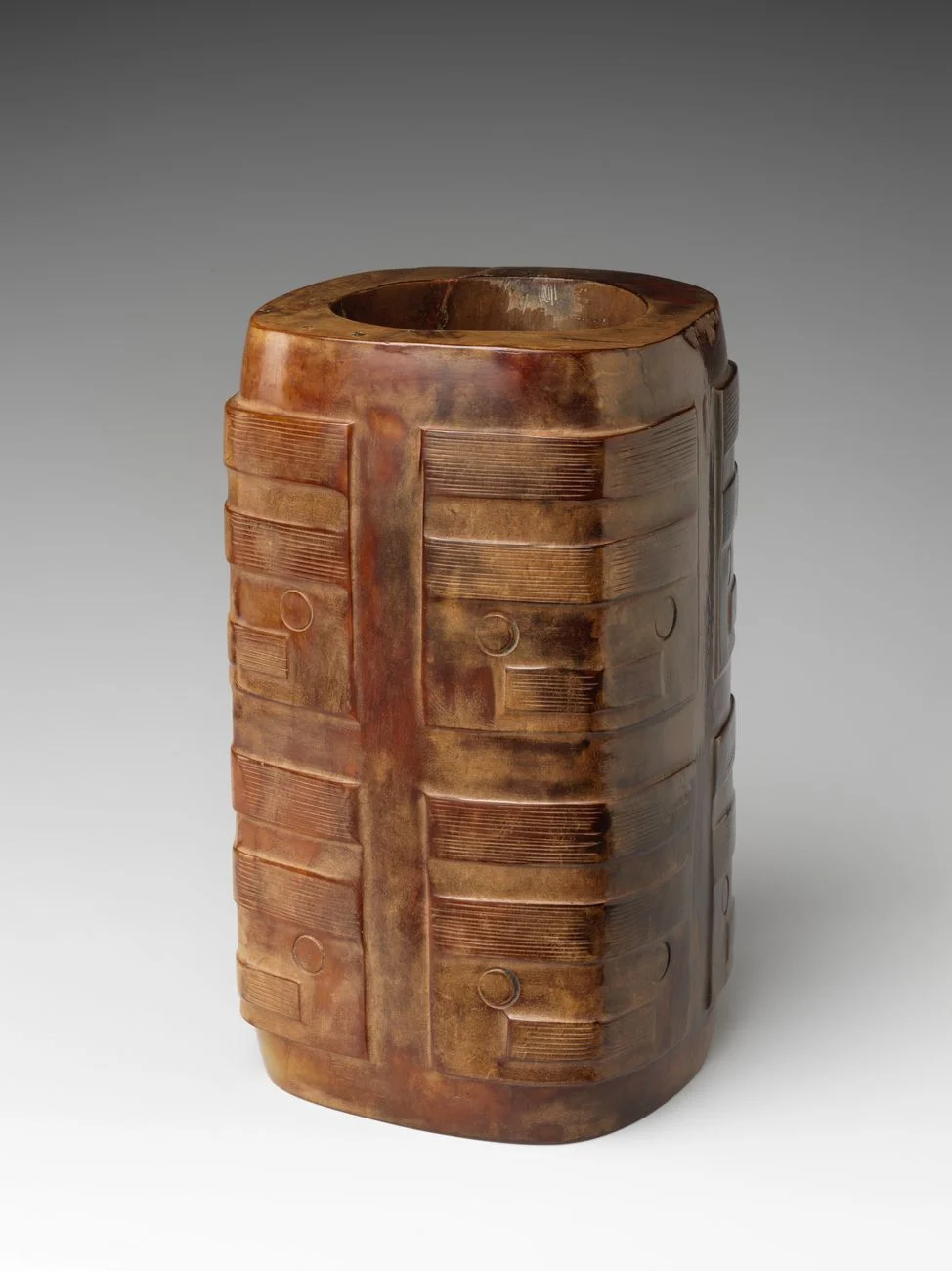
Take the title apart and the evidence base is complete. Ritual is the museum’s word for the class of object; object says it is one piece, not a set; after an ancient jade says the model is older than the carving.
What that older jade was used for does not appear anywhere in the entry.
What the object does show is a decision. Square outside, round inside, cut to the same height, with the pattern held through the whole length.
A carver working a very long time after the original still had a reason to reproduce that. A reproduction is good evidence that the shape mattered, and poor evidence of why.
The dragon ring: a title you can check against the picture
The second object is a ring cut from one piece of pale yellow-green stone and carved as a dragon. The body is twisted like a cord.
The head turns back over its shoulder at the upper left, jaws open, and at the bottom the body crosses itself in a knot.
Both halves of the Met’s title are visible in the photograph, which is not always true of a catalog name. The entry dates the ring to the 3rd century BCE, Eastern Zhou dynasty (770–256 BCE), records nephrite and gives the number 1985.214.99.
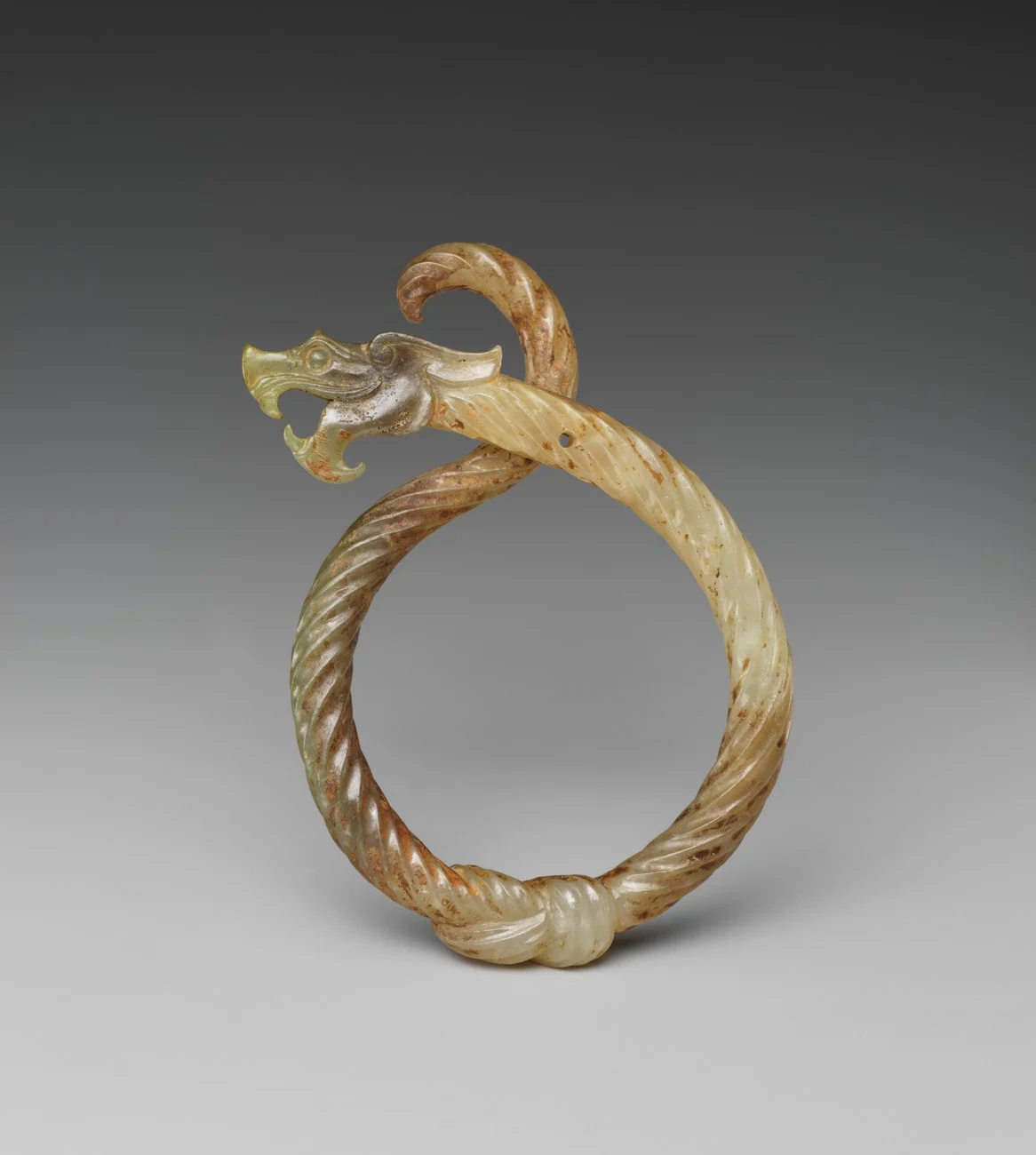
Because name and object agree, this is the easiest of the three records to use, and the one where the missing part is easiest to overlook. A ring of this size implies a cord, a hook or a stitch.
The entry does not say which, and the photograph does not settle it. There is no wear pattern at the knot that would tell you it hung rather than lay flat.
What the carving does record is a problem solved in one material. A dragon, a twisted body and a knot all have to stay continuous in a single loop of stone.
The twist keeps an even rhythm from the head round to the knot. There is no seam where one section of the body meets the next.
Two jade rabbits cut from one stone
The third object is a pair of rabbits lying together, carved from a single piece of stone. One lies with its head down, and the other is rounded against its back.
The color is cream, with heavy russet over the heads and shoulders. The darker stone falls on the parts that are shaped most closely: the head, the folded ear, the curve of the back.
The Met dates the pair to the 14th–15th century, Yuan to Ming dynasty, records the medium only as “Jade”, and gives the number 68.149.6. There is no note on which stone, and no note on what the pair was for.
Two rabbits on one block is a modest subject, and the carving does not treat it as a pair of copies. The two animals differ in how they lie, so the pair reads as one object rather than two animals set side by side.
A pair of rabbits invites a symbolic reading, and this is where most pages start explaining. The entry gives none, and the photograph offers no second subject that would fix one.
Where the meaning part actually comes from
Claims about jade meaning come from three places, and they are not interchangeable. The object supplies form and workmanship.
Texts supply what people wrote about jade, at a date. Use — burial, dress, gift, trade — supplies what people did with the piece, and that needs a find spot or a wear mark before it says anything.
The three records above cover the first place only. They are silent on the second and the third.
What the Met says jade meant
The Met’s exhibition text gives a direct answer to the meaning question. It says jade was revered in China for its natural beauty and for the human values associated with its physical properties: gentle color reflects benevolence, soft luster suggests humility, and extreme hardness and durability call to mind integrity.
The sentence describes jade as a material, not a reading of any one object. The three records still do not assign those values to the cong, the ring, or the rabbits. The broad answer and the object-level evidence stay separate.
This gap is why the page gives the Met’s stated values as the broad answer, and refuses a table matching each shape to an idea unless each line has a dated passage.
An honest version of the reading goes somewhere like this. A text of a certain period describes a certain shape in a certain way, and readers after that point carry the description forward.
The first two steps can be checked. The third — that the person who carved this particular object held that idea — almost never can.
Four things to check on a jade object
Any museum case, catalog photo or product page gives you these four, and each one is a fact and a limit at the same time.
The bore. On the cong it runs the full height and stays round, which is a lot of material removed through a hard stone; that work is visible and needs no label.
The vocabulary. “After”, “in the style of”, “in the archaic manner” tell you that you are looking at a later object made in an older form, before you read a date.
Where the color sits. On the rabbit pair the darker patches and the shaped areas nearly coincide. Whether the carver placed the color or worked around it, the composition treats it as part of the subject.
The finish at the edges. On the ring the twist is polished to the same level as the plain faces, and on the cong the corners are as smooth as the bands.
Work of that kind shows up in a photograph as evenness, not as detail. It is the part of a carving that most snapshots lose.
In the dress reconstruction I do, jade reaches me as fittings — a toggle, a bead, a plaque at a closure — and the questions I can answer about those pieces are stone, size and how each was fixed to the cloth.
The three pieces here are richer than that and no better documented.
What jade meaning comes down to
On the evidence of three objects in one museum, jade meaning is a claim about people rather than about stone. The objects give you carving, date, stone and a number.
What the carving meant comes from texts and from use, and each of those has to be cited on its own terms. Ask which passage, written when, and whether the object’s own record or find spot says anything.
Where there is no answer, the honest label is the one the Met used: this is what the piece is, and this is how far the record goes.
A short list of what an object is beats a long list of what it means.