Chinese embroidery isn’t one technique but a group of them, and the type you name depends on the question you’re asking: what a piece is made of, what it was for, or where it was made.
Read “silk and metallic-thread embroidery” and you’ve got an answer about materials. Read “rank badge” and the answer is about purpose. Read “Su embroidery” and it’s about a place and the teaching that continues there.
Museums often print all three on one small label, which is where the terms start to blur.
The way in is to keep them apart. The three pieces below come from the Metropolitan Museum’s open collection, dated between the late 16th century and the 19th.
None is a textbook example of a regional school. What they show is how differently objects of one craft can be made once you stop calling all of them Chinese embroidery in the same breath.
The ground cloth and the stitching thread are two materials
Object 74103, the panel below, is recorded as silk and metal thread embroidery with small pearls on silk twill.
That line carries four facts: the thread that forms the design, the pearls added to it, the cloth underneath, and the weave of that cloth. Treat them as separate claims, because each one was established in a different way.
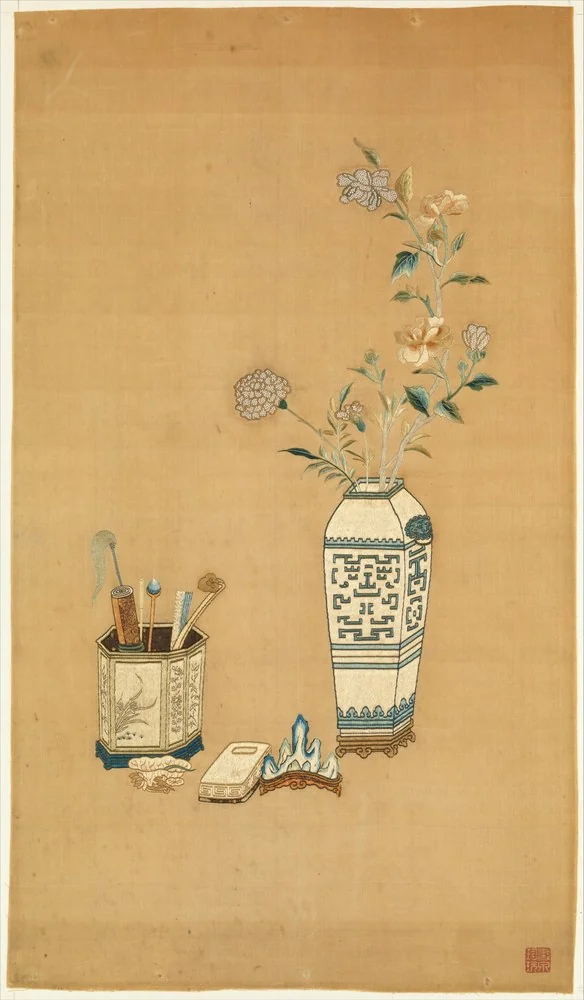
Part of that record your eyes can check. The tan twill is bare cloth, and the vase, the flowers, and the objects on the table are thread laid over it. The edge between the two is easy to trace.
The pearls are another matter. The record lists them, and at this size I can’t pick them out.
That’s the point worth making: the photograph supports the shape of the design, and the label supports the materials.
Silk floss is soft, glossy, and splittable, so a maker can pull one filament into finer strands for a small detail and use several together for a leaf. Metal thread doesn’t work that way.
It’s a strip, flat or wound around a silk core, and it’s usually laid on the surface and tied down with a second, thinner thread instead of being pulled through the cloth like floss.
English textile writing calls that tying-down couching. The effect is a raised, reflective line that outlasts most dyes.
That’s why two pieces from different centuries can look alike in a museum case: the metal stays bright while the silk around it darkens.
The badge later in this guide is dated to the late 16th or early 17th century, the panel to the 18th, and both carry the same two materials.
Material is a weak guide to date, and a date tells you nothing about purpose. That gap is where the next set of types begins.
If you want the ground, the stitch names, and the four regional names laid out together, Chinese embroidery sets them in that order.
Purpose splits the types again: badge, panel, chair strip, dress
Nothing in the thread count tells you what a piece was for, and purpose is the axis most readers actually care about.
Rank, display, furniture, and dress are four jobs that produce four different objects, even when the stitching is done in the same manner. The badge below is the formal kind.
A rank badge (补子, buzi) was a square panel worn on the front or back of an official’s robe, and the animal on it announced the wearer’s place in the court hierarchy.
The badge here is nearly square at 14 7/8 by 15 inches (37.8 by 38.1 cm).
Civil officials wore birds and military officials wore animals. Dragons sat above both, and the number of claws was counted as part of the ranking.
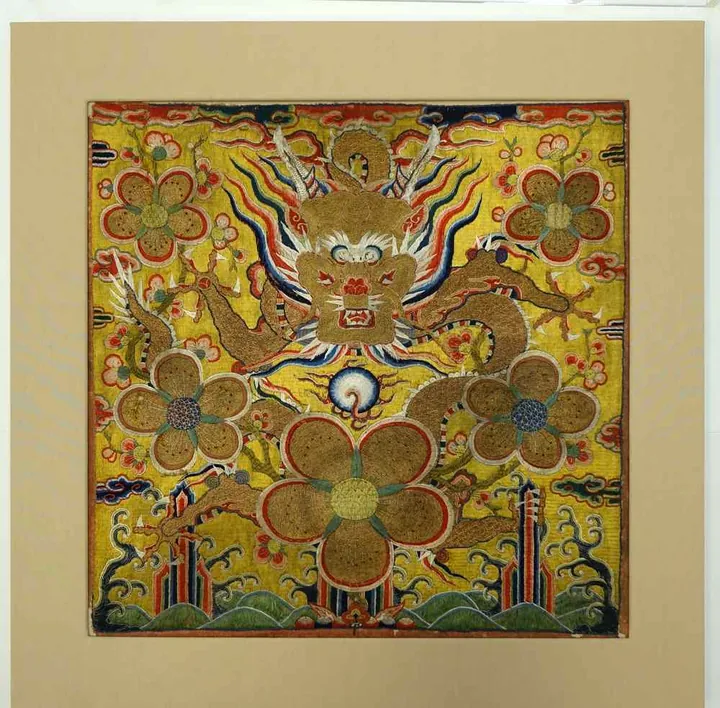
Read that badge at a distance and it still works: a gold ground, a symmetrical dragon, a border. That’s how it was meant to be seen, across a courtyard, on a man standing in a row of other officials.
The panel earlier in this guide was made to be looked at rather than worn. Its rewards sit in the small things instead, down to the seal in the corner.
Furniture is the third job. A chair strip covers the back of a chair, so it’s a long, narrow shape with a design that has to work along its length.
The cover image on this page is the central band of one, not the whole strip: silk gauze, metal thread, gold dragons among red and green cloud scrolls, a red and orange medallion.
The full strip, which the museum dates to the 19th century, measures 69 1/2 by 18 1/4 inches (176.5 by 46.4 cm). Gauze is an open weave, sheer enough that the embroidered design carries most of what the cloth has to offer.
Dress is the fourth job, and the one most people picture. Embroidery on a robe can run along a border, surround an opening, or fill a panel at the chest.
Traditional Chinese clothing separates robes, ensembles, and forms of dress before it examines details, because a stitched peony on a skirt hem and a dragon on a badge belong to different systems.
A place name points to an embroidery school, not to a look
Su, Xiang, Shu, and Yue are the four names most often printed in English, and each one points to a region: Suzhou and nearby parts of Jiangsu, Hunan, Chengdu and nearby Sichuan, and Guangdong.
What the name gives you is a place to look, a body of teaching, and a set of records to search. What it doesn’t give you is a visual test.
Two makers within one tradition can stitch the same peony differently, and a peony worked in Suzhou and one worked in Guangzhou can look alike at arm’s length.
The stitch is a separate question from the school, and a comparison of embroidery stitches takes up the shapes that thread leaves on cloth: broken lines, linked loops, raised dots, filled areas.
Beyond the four names, the field includes Gu embroidery (顾绣, guxiu) from the Songjiang area that’s now part of Shanghai. Gu work is known for pictorial scenes that follow paintings.
Beijing embroidery is tied to the court workshops. The embroidery of Miao communities in Guizhou is often dense and geometric in a way that Suzhou work isn’t.
UNESCO’s record of Li textile techniques covers embroidery among the spinning, dyeing, and weaving done by Li women in Hainan. That list isn’t a ranking, and the famous four aren’t the whole country.
A regional label is also a claim about attribution, and attribution needs a maker, a workshop record, or a documented collection history. A museum that writes “Chinese” without a province is usually saying that the evidence stops there.
Woven, printed, and sewn-on patterns are not embroidery
One further confusion changes how you look at a piece.
Kesi (缂丝, kesi) is a silk cloth woven on the loom, weft by weft, with small separate shuttles, so the picture is part of the cloth from the start.
It shares silk, color, and pictorial ambition with embroidery and hangs beside embroidered panels in museum cases. It isn’t embroidery.
The Suzhou workshops that weave it call it weaving, and so do the kesi makers I’ve worked with there.
Appliqué sits closer and is still separate: a piece of cloth is cut and stitched onto the ground, so the design is fabric rather than thread.
Printed and dyed patterns sit inside the cloth as well. A printed imitation of embroidery, common on modern clothing, is a picture of stitches rather than stitches, and the difference shows at the edge of a motif, where real thread has thickness.
The guide to traditional Chinese textiles keeps fiber, weave, and added decoration apart, which is where this distinction belongs.
Read an embroidery label in layers: material, object, place, date
Take any label and read it in that order.
Material and date usually come from technical examination and the collection record. The object type comes from its shape and from the way it was worn, hung, or used.
Place is the weakest of the four on most labels, because a style can travel and a workshop can move. When a card gives only one of them, the other three are the questions to carry to a curator or a maker.
If you aren’t sure which of the four questions you’re holding, the home page of China in Threads groups the guides by garment, material, and detail, and each one takes a single question further.
That’s the shape of the work here: the object, the record, and the hand that made it, which is as much as a photograph will honestly support.