Hanfu includes separate tops and skirts, joined robes, and outer layers. Two names worth learning first are ruqun (襦裙), a short top with a skirt, and aoqun (袄裙), a jacket-and-skirt outfit with the jacket worn outside the skirt. Other names identify a robe, a vest, or the skirt alone.
That difference explains why lists of hanfu types can look so unlike one another. A complete outfit and one piece of it can appear side by side. The photographs here show a few useful details, not a visual catalogue of every name below.
What are the main types of hanfu?
Common hanfu names describe several levels of clothing: an outfit, a single garment, or a feature of its cut. Ruqun and aoqun describe top-and-skirt combinations. A skirt name tells us about the lower garment, while a collar name says much less about what accompanies it.
The table groups names by what they describe. Read the last column as a prompt to inspect the clothes; a label becomes easier to understand when it points to a visible edge, seam, or opening.
| Name | What it names | Where to look |
|---|---|---|
| Ruqun | A short top and separate skirt | The skirt waist and the top beneath it |
| Aoqun | A jacket worn outside a separate skirt | The jacket hem over the skirt |
| Shenyi (深衣) | A garment with upper and lower sections joined together | The construction at the waist |
| Zhiju (直裾) and quju (曲裾) | Straight and wrapping forms of the garment’s front | The lower front and where it continues around the body |
| Yuanlingpao (圆领袍) | A round-collar robe | The neckline and the long body beneath it |
| Beizi (褙子) | An outer garment; the Song example discussed below has sleeves and side slits | The front opening, sleeves, and sides |
| Bijia (比甲) | A vest | The arm openings and the garment worn beneath it |
| Mamianqun (马面裙) | A skirt with flat panels and pleated sides | The skirt front, back, and side folds |
Several labels can describe clothes worn together, so a skirt and outer garment can keep separate names within one outfit. The table is a naming guide; use a photograph only for features it actually shows. These names sit within the broader hanfu dress tradition.
Ruqun and aoqun: follow the hanfu skirt waist
Ruqun and aoqun make a clear starting comparison because both have a separate upper garment and skirt. In the ruqun arrangement, the skirt sits over the lower part of the top. For aoqun, look for the jacket’s hem hanging outside the skirt.
The skirt’s height adds another description. Qiyao means waist-level; qixiong means chest-level. These words tell us where the skirt is worn, so a qixiong label describes a different waist position from a qiyao label, even before color or decoration enters the comparison.
When a photograph includes the full waist, trace the skirt’s upper edge across the body. A sash or jacket may hide that edge. If the waist or jacket hem falls outside the frame, the photograph cannot settle the label.
The China National Silk Museum’s account of Tang women’s clothing describes short tops with long skirts, whose waists could reach the underarms. That gives a historical example of a high skirt waist. A modern outfit still needs its own description of the top, skirt, and way they’re worn.
Aoqun also names a combination, so the word alone leaves the skirt’s construction open. A jacket can conceal its waistband while the lower skirt remains visible. Check the jacket hem first, then inspect the skirt as a separate piece; the two observations answer different questions.
Hanfu robes: shenyi, zhiju, quju, and yuanlingpao
Robes change the question from where two garments overlap to how one garment is built. A shenyi joins upper and lower sections into a single garment. A waist seam is therefore a construction clue, while a belt simply shows where cloth has been gathered on the wearer.
Zhiju and quju concern the front’s shape and path. In the straight form, the lower front falls without the extended wrapping seen in quju. For the wrapping form, a side or rear view matters: the cloth continues around the body, beyond what a small front view can show.
Keep the terms separate when reading a listing. A straight-front label doesn’t, by itself, prove that the upper and lower sections were cut separately and joined as shenyi. The Jiangxi Institute of Fashion Technology’s museum specifically cautions against treating zhiju and zhiju shenyi as identical terms.
The two modern outfits below share crossed fronts, but their visible details differ. Gold-colored edging follows the purple garment’s opening and cuffs. On the pale green outfit, black and red bands frame the neck and sleeve ends, with several skirt colors visible below.
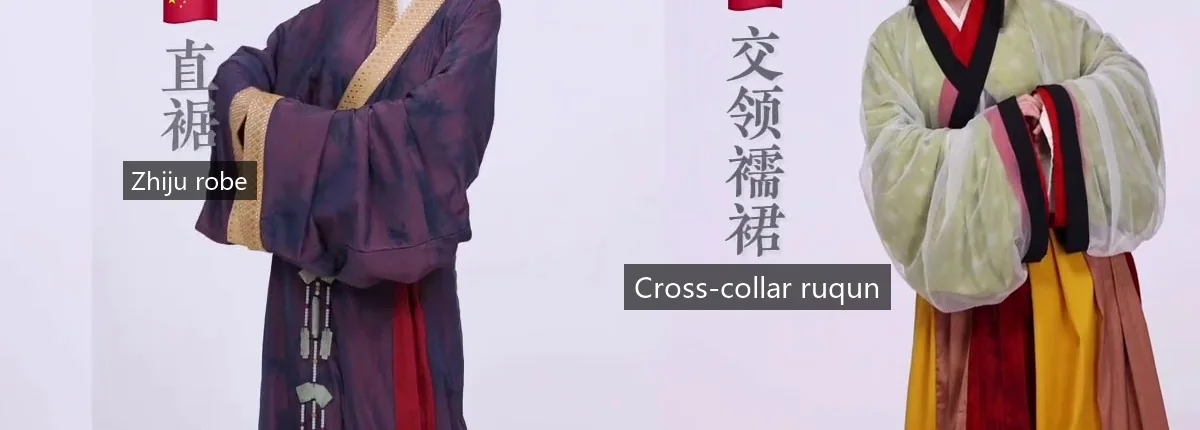
The labels help name the comparison, but the crop stops before the full hems. To distinguish a straight front from a wrapping one, follow the garment farther down and around the side. The collar alone won’t settle that difference.
A yuanlingpao puts the round collar in its name. The neckline contrasts with the crossed fronts above, but the robe also has a full body, sleeves, and an opening to inspect. A round neckline can guide the first look without identifying a particular wearer or historical rank.
Beizi, bijia, and mamianqun are pieces of a hanfu outfit
An outer layer can cover much of the robe or separates beneath it. A beizi is one such garment. The China National Silk Museum describes an example from Zhou’s Southern Song tomb with narrow sleeves, side slits, and a small button at the front.
A bijia is a vest, as the Ministry of Education’s Chinese dictionary defines it. The practical distinction to inspect is the arm opening. Sleeves visible around a vest belong to the garment underneath, which can make a dressed outfit misleading if the layers have similar colors.
Look at where a sleeve joins its own body panel. In the blue outfit below, the hanging blue sleeve sits beside a pale inner cuff. On the ivory side, small motifs continue across the broad outer sleeve, with a pink layer visible through the open front.
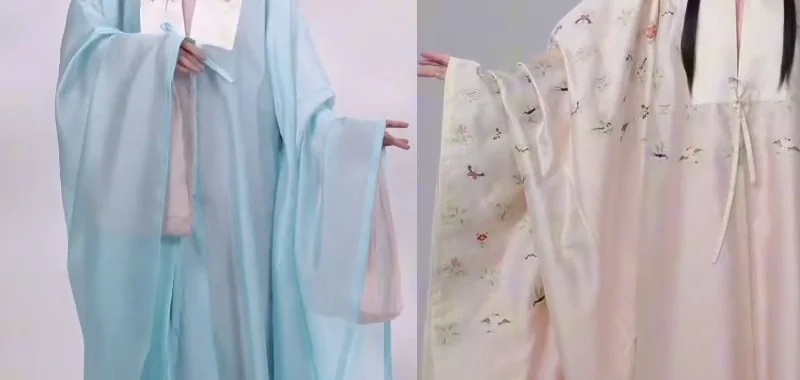
A square neckline is a further detail to record when inspecting a bijia. It says where the opening runs across the chest; the armholes tell us whether the piece itself has sleeves. Both need to be visible before using a small photo as a shape reference.
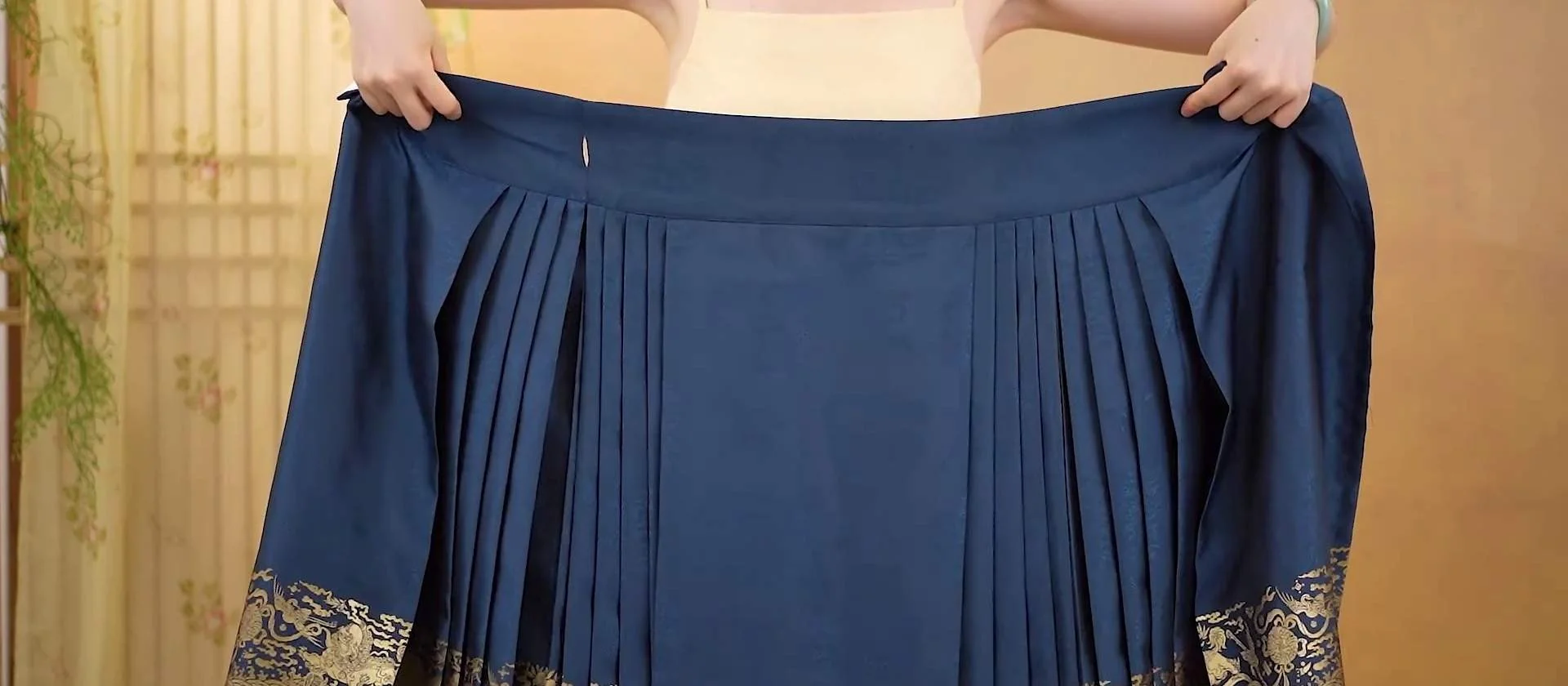
Mamianqun names the skirt below those upper layers. Its flat sections sit between banks of pleats, so the folds are not distributed evenly across the whole front. The skirt held open below shows that contrast without asking a dressed silhouette to prove it.
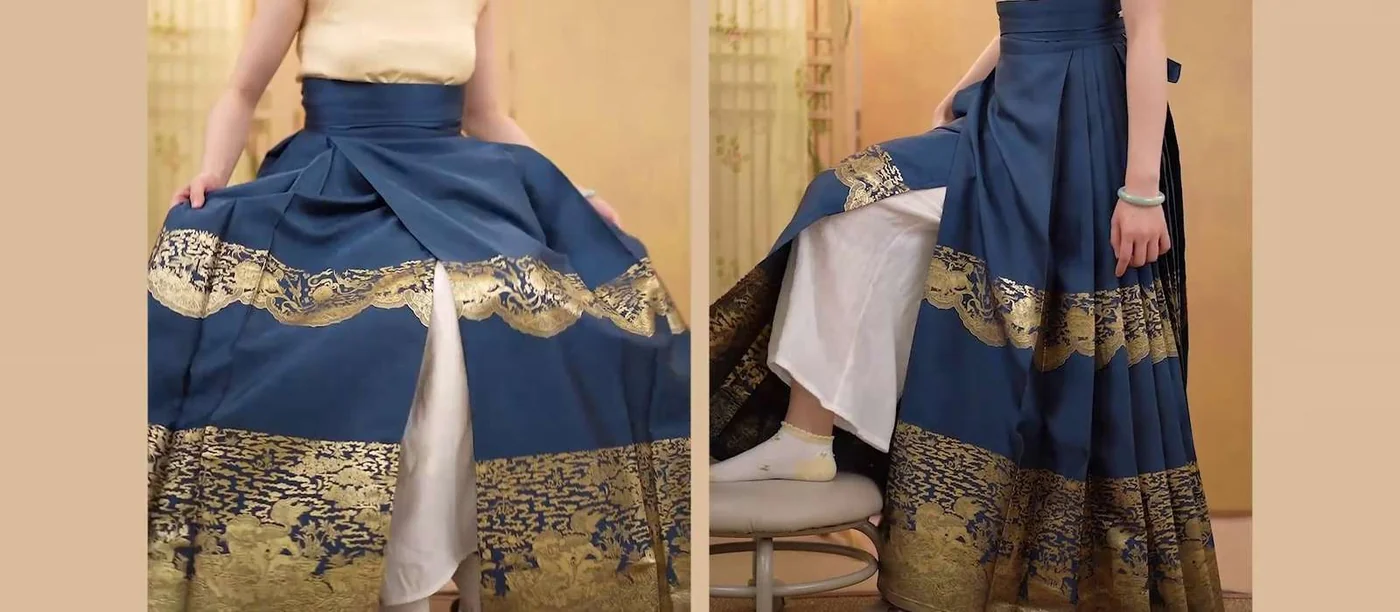
A second view shows why one still image can hide part of the construction. When the skirt opens during sitting or a raised step, a pale underlayer appears between the blue panels while the side pleats remain visible.
The China National Silk Museum’s red floral example makes that contrast explicit: its record describes front and back panels, with pleats beside the flat section. The surviving skirt is dated to the Qing period. That single object also warns against assigning every skirt with this name to one dynasty.
Hanfu dynasty labels: a period is more than one silhouette
Dynasty labels add historical context to garment names. Tang, Song, and Ming refer to periods; a skirt, vest, or robe is a piece of clothing. Combining a period reference with a garment name makes the description more precise than using the period alone. Hanfu belongs within traditional Chinese clothing.
For Tang clothing, a high-waisted skirt and a round-collar robe lead to different silhouettes within the same broad period. The silk museum’s account discusses both. Calling an outfit Tang-style still leaves the reader needing to know which clothing it draws on.
The silk museum’s account of Song women’s beizi describes a long outer garment worn with a pleated skirt. Those are separate pieces with different edges to inspect. Learning the outer garment’s name still leaves the skirt beneath it to identify.
For a modern outfit, keep two notes: what pieces are present, and what historical reference is claimed. Then request the view that answers the remaining shape question: the waist for a hidden skirt edge, the side for a wrapping front, or the armhole for a vest.
Once those details are visible, the names become much easier to use. A description such as a jacket worn outside a pleated skirt already says more about the clothes than a dynasty label on its own. Add the particular garment name when the construction supports it.